
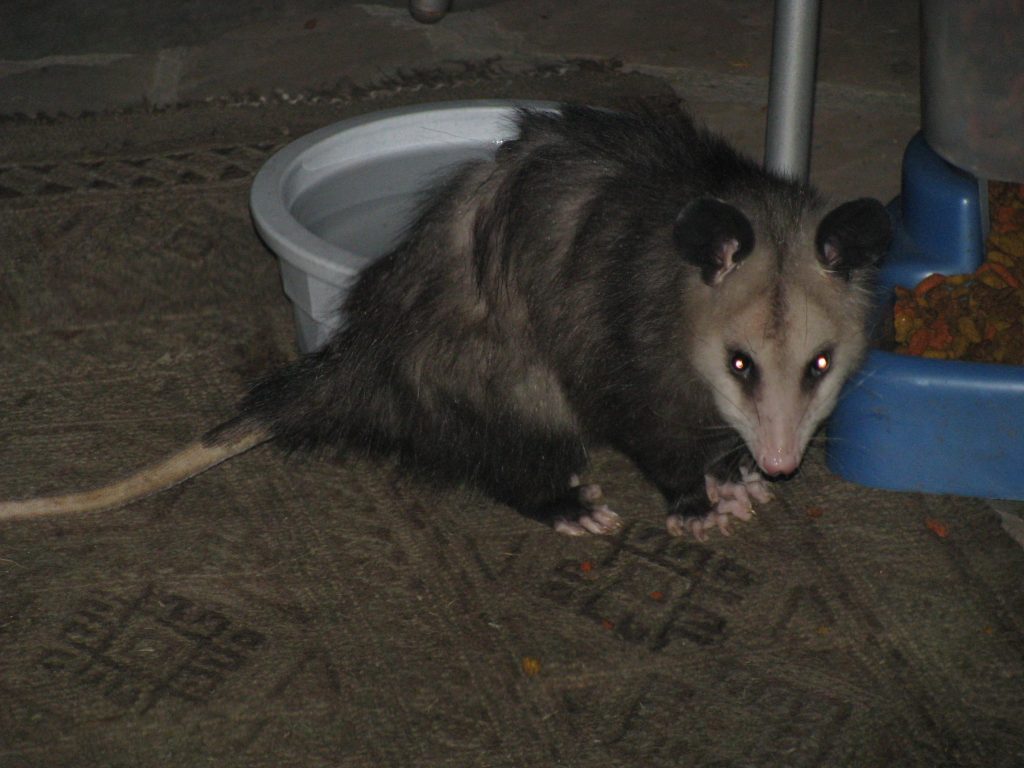
Few backyard visitors get a worse first impression than the opossum. With a pointed, toothy grin and a bare, scaly tail, North America’s only marsupial tends to startle homeowners who find one shuffling across the patio at night or denning under the deck. But opossums are also one of the most misunderstood animals in Florida, equal parts genuine nuisance and unexpected ally.
If one has moved in under your porch, deck, shed, or into your attic this summer, here’s a clear-eyed look at the risks, the benefits, and the right way to handle it across Manatee and Sarasota counties.
Why Opossums Den Near Homes
Opossums are opportunists. They’re drawn to residential areas by the same three things every nuisance animal wants: easy food, water, and shelter.[^1] In summer, the sheltered, dry pockets beneath porches, decks, sheds, and crawlspaces make ideal denning sites, safe from predators and weather, and they’ll readily climb into an attic if they can reach one.[^2]
They’re not picky eaters, either. As omnivores and scavengers, opossums will work through fallen fruit, insects, small animals, pet food left outdoors, compost, and unsecured garbage.[^1] If your property offers a reliable meal, an opossum is likely to keep coming back, and once it finds good shelter, it may settle in.
The Good News First: Opossums Earn Their Keep
Before we get to the downsides, it’s worth giving opossums their due, because they do real ecological work.
University of Florida researchers note that opossums are prolific tick consumers, eating large numbers of them each season, which makes them quiet allies against tick-borne illness.[^3] As scavengers, they also clean up carrion, which helps limit the spread of disease, and they disperse seeds from the fruit they eat.[^3] On top of that, opossums very rarely carry rabies — their naturally low body temperature makes them poor hosts for the virus — and they’re generally shy, non-aggressive animals that would rather bluff (or “play dead”) than fight.[^3]
None of that means you want one living under your house. But it does mean the goal should be humane removal and exclusion, not harm.
The Real Risks
Opossums become a genuine problem when they take up residence in or under a structure. The concerns fall into three buckets:
Disease. Infected opossums can transmit leptospirosis to people and pets through their urine and feces, and they’re associated with other illnesses including salmonella, tularemia, and toxoplasmosis.[^4][^5] Leptospirosis in particular spreads through contaminated urine and contact with broken skin or mucous membranes — which is one reason a den site near where your family and pets spend time is worth addressing.[^4]
Parasites. Opossums are frequently loaded with fleas, ticks, mites, and lice, and they shed flea eggs and larvae wherever they spend time.[^4][^5] A den under your deck can quietly seed a flea problem for your pets and yard.
Mess and conflict. Their droppings accumulate at den sites, they raid pet bowls and garbage, and they can get into fights with dogs and cats — and an opossum’s mouthful of sharp teeth can cause real injury in a scuffle.[^1]
It’s also why you should never try to handle an opossum by hand: the parasites alone make hands-on capture a bad idea.[^5]
Florida’s Rules Matter Here
Opossum removal in Florida comes with legal requirements that catch a lot of DIY trappers off guard. Live-captured nuisance opossums must be released or euthanized within a set window after capture, relocation is tightly restricted by location and acreage and may require written permission from the release-site owner, and any handling has to account for active rabies alerts or quarantines in your county.[^5] Relocation is also frequently not biologically sound — relocated animals often don’t survive.[^5]
Translation: this is exactly the kind of job where a licensed professional saves you from accidentally breaking the rules while solving the problem properly.
How Wildlife Trapper Handles Opossums
At Wildlife Trapper, opossum removal is a routine call across Manatee and Sarasota counties, and our process is built to handle both the animal and the conditions that attracted it:
- Inspection. We confirm the den site (under the porch, deck, shed, or in the attic), look for young, and identify how the animal is accessing the space.
- Humane trapping and removal. We use safe trapping techniques and handle the animal in compliance with Florida’s regulations.
- Exclusion. We seal off the den site — screening under decks and porches, closing crawlspace and attic entry points — so another opossum can’t simply move into the vacancy.
- Cleanup. We address droppings and contamination at the den or attic site to remove the health and odor concerns left behind.
We’re licensed, insured, family-owned, and have served the region for more than 20 years using humane methods and no poisons.
Make Your Property Less Inviting
A few simple steps go a long way toward keeping opossums from settling in:
- Secure the food. Use tight-fitting lids on garbage cans, feed pets during the day and bring bowls in at night, and pick up fallen fruit and windfall promptly.[^6]
- Take in water sources like pet water bowls overnight.[^6]
- Screen the gaps. Close off the open space under porches, decks, and sheds before something moves in.
- Trim and clean up overgrown shrubbery and brush that offer cover near the house.
- Seal the structure so opossums can’t reach the attic via the roofline.
When To Call
If you’ve seen an opossum repeatedly denning under your deck or porch, are hearing nighttime activity in the attic, or have noticed droppings and a musky odor around the structure, it’s time to deal with it before parasites and contamination spread.
Wildlife Trapper serves Manatee, Sarasota, and Charlotte counties plus the greater Tampa Bay area. Find your area on our service areas page, and book a free inspection through our contact page.
📞 Call or text: (941) 729-2103 | Toll Free: 1-866-263-WILD | 24/7 Emergency Service Available
Footnotes & Sources
All sources are publicly funded university extension materials, government agencies, or public-health references appropriate for commercial citation. Content above is original and paraphrased.
[^1]: UC Agriculture & Natural Resources / IPM — Opossums (attractants, diet, conflicts): https://ipm.ucanr.edu/PMG/PESTNOTES/pn74123.html
[^2]: UF/IFAS Extension — Nuisance Wildlife (denning behavior and structures): https://sfyl.ifas.ufl.edu/natural-resources/nuisance-wildlife/
[^3]: UF/IFAS Extension Lee County — Nuanced Wildlife: Opossum (tick consumption, scavenging, low rabies risk): https://blogs.ifas.ufl.edu/leeco/2025/07/02/nuanced-wildlife-opossum/
[^4]: Los Angeles County / public-health guidance — Managing Opossum Problems (leptospirosis transmission, parasites): https://animalcare.lacounty.gov/wp-content/uploads/2024/12/029450_L_ELivingwithwildlife-Opossum2.3.15.pdf
[^5]: Florida Fish and Wildlife Conservation Commission (FWC) — Nuisance Wildlife (legal handling, relocation rules, rabies alerts): https://myfwc.com/wildlifehabitats/wildlife/nuisance-wildlife/
[^6]: UF/IFAS Extension — Solutions for Your Life: Nuisance Wildlife (reducing food, water, and shelter attractants): https://sfyl.ifas.ufl.edu/natural-resources/nuisance-wildlife/